Residential Appraisals
Residential Appraisals in Boston, Massachusetts
Prime Value Appraisals prepares residential home appraisals in Boston and across Suffolk County. Our Licensed and Certified appraisers deliver market-informed valuations for owners, buyers, estate representatives, investors, attorneys, and lenders.
Home Appraisals in Boston
Boston is the capital city of Massachusetts and the core of the Greater Boston metro area. Composed of neighborhoods that were once separate towns annexed between the 1800s and 1912, the city contains a wide range of residential property types within a single municipality. Prime Value Appraisals prepares residential appraisals throughout Boston for owners, buyers, estate representatives, attorneys, CPAs, and lenders, with attention to how each neighborhood's housing stock and lot characteristics shape the assignment.
The work is performed by our Senior Appraiser / Founder, Luciano Giorgio, a Certified Residential Appraiser with over 15 years of experience in the region.
An appraisal forms a defensible opinion of a property's market value by considering the real estate itself, the assignment's purpose and intended users, and relevant market evidence such as recent comparable sales. The scope of work, effective date, and intended use shape how that evidence is developed and reported, so two appraisals of the same home can differ when the purpose differs. Luciano Giorgio, our Senior Appraiser / Founder, is a Certified Residential Appraiser with over 15 years of experience in the region.
Residential Property Appraisals in Boston
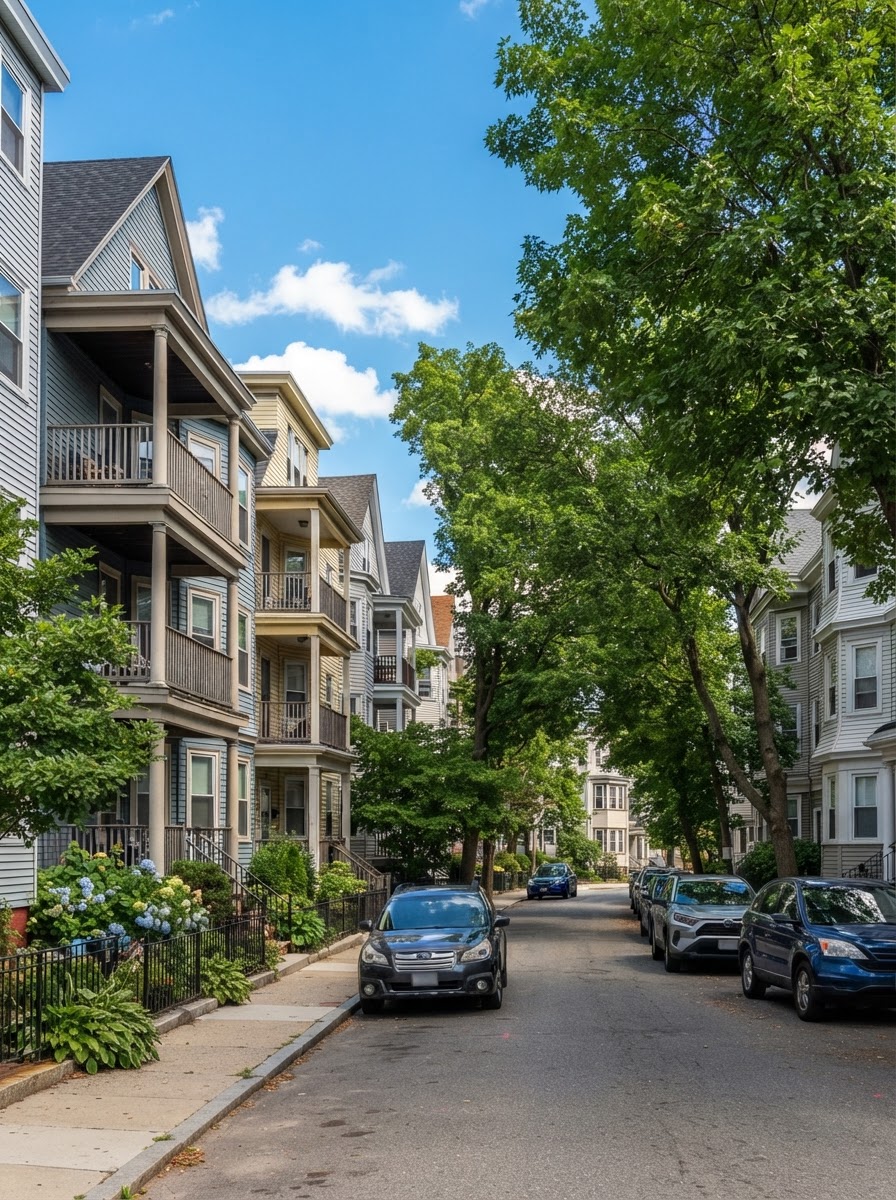
In Boston we appraise the residential property types the firm handles across its service area, including single-family homes, two- and three-family triple-deckers, condominiums and townhomes in converted multi-family buildings, custom and newer construction, and vacant land. Because Boston's housing spans Federal-style row houses, Victorian brownstones, and late-19th-century wood-frame triple-deckers, living area layout, legal unit status, construction era, and any renovation or conversion history are often central to the valuation.
Boston's residential lots are among the smallest in the region, and site characteristics, parking, zoning, and any access or easement details can differ meaningfully even between nearby properties. The scope of work, effective date, and intended use of each assignment determine how these characteristics are weighed.
Valuation methods and the selection of comparable sales depend on the assignment. A feature that is central to one report may carry little weight in another, and no characteristic automatically adds or subtracts a set amount of value. We develop each opinion through the sales comparison, cost, or income approach as appropriate to the property type and intended use, and we describe how the relevant characteristics were considered within the scope of that specific assignment.
Boston Housing and Appraisal Considerations
Boston's residential stock is unusually varied for a single city. Older inner neighborhoods such as Beacon Hill, Back Bay, and the South End are dominated by attached Federal and Victorian-era row houses and brownstones, many now held as condominium units, while Dorchester, Roxbury, Mattapan, and Jamaica Plain contain large numbers of wood-frame triple-deckers built largely between the 1880s and 1930. South Boston's triple-deckers are typically flat-roofed, Roxbury's are pitched, and Dorchester shows a mix of both, so roof form and architectural style can help distinguish otherwise similar properties when selecting comparables.
Per the Boston Planning & Development Agency's residential land use analysis, single-family homes make up a much larger share of residential land in outer neighborhoods such as West Roxbury (about two-thirds) and Hyde Park (over half), while Roslindale, Mattapan, Jamaica Plain, and Dorchester each devote roughly a third or more of residential land to single-family use alongside substantial two- and three-family stock. These differences mean comparable selection often benefits from attention to the specific neighborhood, lot size, and unit count rather than citywide averages.
Because Boston neighborhoods vary in density, transit access, zoning, and lot characteristics, comparable selection often benefits from attention to site and neighborhood characteristics rather than reliance on city-wide figures. Each assignment's intended use and intended users determine how much weight these factors carry; local market conditions are a documented context, not a value conclusion for any individual property.
Residential Appraisals for Your Specific Needs
Prime Value Appraisals prepares residential appraisals for several assignment purposes. Each differs in intended use, intended users, effective date, and scope, and the process is tailored accordingly rather than applied uniformly.
Valuations for estate planning, probate, and trust administration, often requiring a retrospective effective date.
Retrospective valuations establishing a property's market value as of a specific past date for estate settlement and step-up in basis.
Impartial valuations supporting equitable distribution, with attention to the effective date and intended users required by the matter.
Defensible opinions of value used to contest assessed values, reflecting the relevant appraisal date and jurisdictional standards.
A pre-marketing opinion of value to help owners and agents set a listing price supported by comparable market evidence.
Independent valuations for buyers and sellers making informed decisions about a pending or contemplated transaction.
More Appraisal Coverage in Suffolk County
Other Counties We Serve
We service the following Property Types
Our certified appraisers have extensive experience across a diverse range of residential properties in the Greater Boston Metro Area.
Get Started Today
Request Your Free Appraisal Quote
Please fill out the form for a quick quote, or call us directly. We'll review your property details and get back to you promptly.
978-440-1788- Accurate, unbiased opinion of value
- Confident decisions backed by real data
- Professionally defensible reports
- Fast turnaround times — never left waiting
- Local expertise from a true market specialist
- Direct access to your appraiser from start to finish